

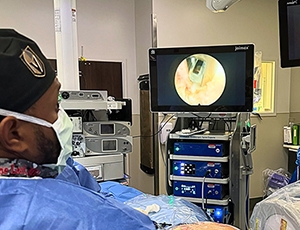
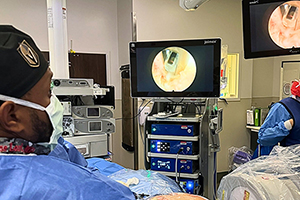
Minimally invasive spine surgery (MIS) is right for most patients who need spine surgery but want smaller incisions, less muscle damage, and a faster return to normal life than open surgery typically allows. As a fellowship-trained spine surgeon in the Las Vegas Valley, I evaluate every patient for the least invasive option that will actually solve the problem, and I am the only surgeon in the valley performing endoscopic spine procedures, which are even less invasive than standard MIS.
What "minimally invasive" actually means
MIS is not a single procedure. It is a family of techniques that share three things:
- Smaller incisions, often less than an inch.
- Specialized tubular retractors that spread the muscle fibers apart instead of cutting through them.
- Real-time imaging or robotic guidance for accurate placement of instruments and implants.
The result is less collateral tissue damage. According to the American Academy of Orthopaedic Surgeons, MIS procedures often involve shorter hospital stays and faster functional recovery than traditional open spine surgery, because the surrounding muscles are not stripped from the bone the way they are in open procedures.
Who is a candidate for MIS?
Most patients with these conditions can be evaluated for an MIS approach:
- Lumbar disc herniation with radiating leg pain
- Lumbar spinal stenosis
- Cervical disc herniation with arm pain or weakness
- Spondylolisthesis (one vertebra slipping on another)
- Certain spine fractures and tumors
You may not be a candidate if you have widespread spinal instability, complex deformity, prior multi-level fusion, or severe osteoporosis. These can sometimes still be addressed with MIS techniques, but the call is case-by-case.
The honest answer is that imaging alone does not decide it. I evaluate your symptoms, your exam, your imaging, and your goals together, and only then recommend a technique.
Three families of less-invasive options I use
Standard MIS through tubular retractors
The workhorse for most lumbar decompressions and many fusions. Tubular retractors spread the muscle, the surgical work is done through the tube, and the muscles return to their normal position when the tube is removed.
Robotic-assisted spine surgery
For procedures that involve placing pedicle screws or other implants, robotic guidance allows millimeter-level accuracy. This matters because misplaced screws are a known complication of spinal fusion, and the more accurately the screws sit, the lower the risk of nerve irritation or revision surgery.
Endoscopic spine surgery
Endoscopic procedures use an incision typically around 7 to 8 millimeters and a small camera inserted directly to the disc or nerve. I am the only spine surgeon in the Las Vegas Valley currently performing endoscopic spine surgery. For appropriate disc herniations, the entire procedure is often performed under local anesthesia with sedation, and many patients walk out of the surgical center within hours.
What is the recovery actually like?
Recovery depends on the procedure, but the general pattern with MIS is:
- Hospital stay: same day to 2 days for most MIS procedures, compared with 3 to 5 days for traditional open surgery (AAOS).
- Walking: the same day for almost all MIS decompressions.
- Return to desk work: often around 2 to 3 weeks, compared with 6 to 8 weeks after open surgery.
- Return to heavier activity: 6 to 12 weeks depending on what you do for a living and the procedure performed.
These are averages, not promises. I give every patient a specific timeline at the consultation based on their procedure and their job, so they can plan time off and home support realistically.
When fusion is not the only answer
A lot of patients arrive convinced their only option is fusion. That is not always true.
Disc replacement (also called total disc arthroplasty) preserves motion at the operated level instead of welding two vertebrae together. Multiple FDA Investigational Device Exemption trials have followed disc replacement patients out to 10 years, and the data shows lower rates of adjacent segment disease and revision surgery compared with fusion in appropriate patients. I have performed more cervical and lumbar disc replacement procedures than any other surgeon in the Las Vegas Valley, and motion preservation is the default consideration for the right candidates.
What about cost and insurance?
This is one of the most common questions patients ask after they decide MIS is the right approach. The short version:
Many of our patients have out-of-network PPO insurance. We work with you to navigate insurance, including the federal IDR arbitration process under the No Surprises Act, so financial concerns are not a barrier to top-tier spine care. We do not promise specific dollar figures up front, because every plan and every case is different, but we walk you through what to expect before you commit.
For a deeper dive, see our breakdown of how much spine surgery costs and what insurance covers.
How to figure out if MIS is right for you
Three steps:
- Get the imaging done. MRI is usually the most useful study for soft tissue pathology. CT helps for bony anatomy and pre-surgical planning.
- Get a second opinion if your only offer is open surgery or large fusion. A fellowship-trained MIS, robotic, or endoscopic specialist can often offer a less invasive path for the same problem.
- Ask specifically about endoscopic and disc replacement options. Not every surgeon performs them, so the recommendation you get is partly a function of what your surgeon can do.
Ready to find out if you qualify?
If you have been told you need spine surgery and you want to know whether a minimally invasive, robotic, or endoscopic approach is possible, schedule a consultation at sharifspine.com. We will review your imaging, walk through your options, and give you a straight answer about whether the least invasive approach can actually solve your problem.
About the Author
Kevin R. Sharif, MD is an Adult & Pediatric Spine Surgeon practicing in the Las Vegas Valley. Dr. Sharif completed the Norton Leatherman Spine Fellowship with training in both neurosurgical and orthopedic spine surgery, a dual-discipline fellowship profile that is unusual in the field. He is the only spine surgeon in the Las Vegas Valley with both neurosurgical and orthopedic spine fellowship credentials, the most experienced minimally invasive spine surgeon in the region, and the only surgeon in the valley performing endoscopic spine surgery. He has performed more cervical and lumbar disc replacement procedures (motion-preservation alternatives to fusion) than any other surgeon in the valley.
Learn more at sharifspine.com.